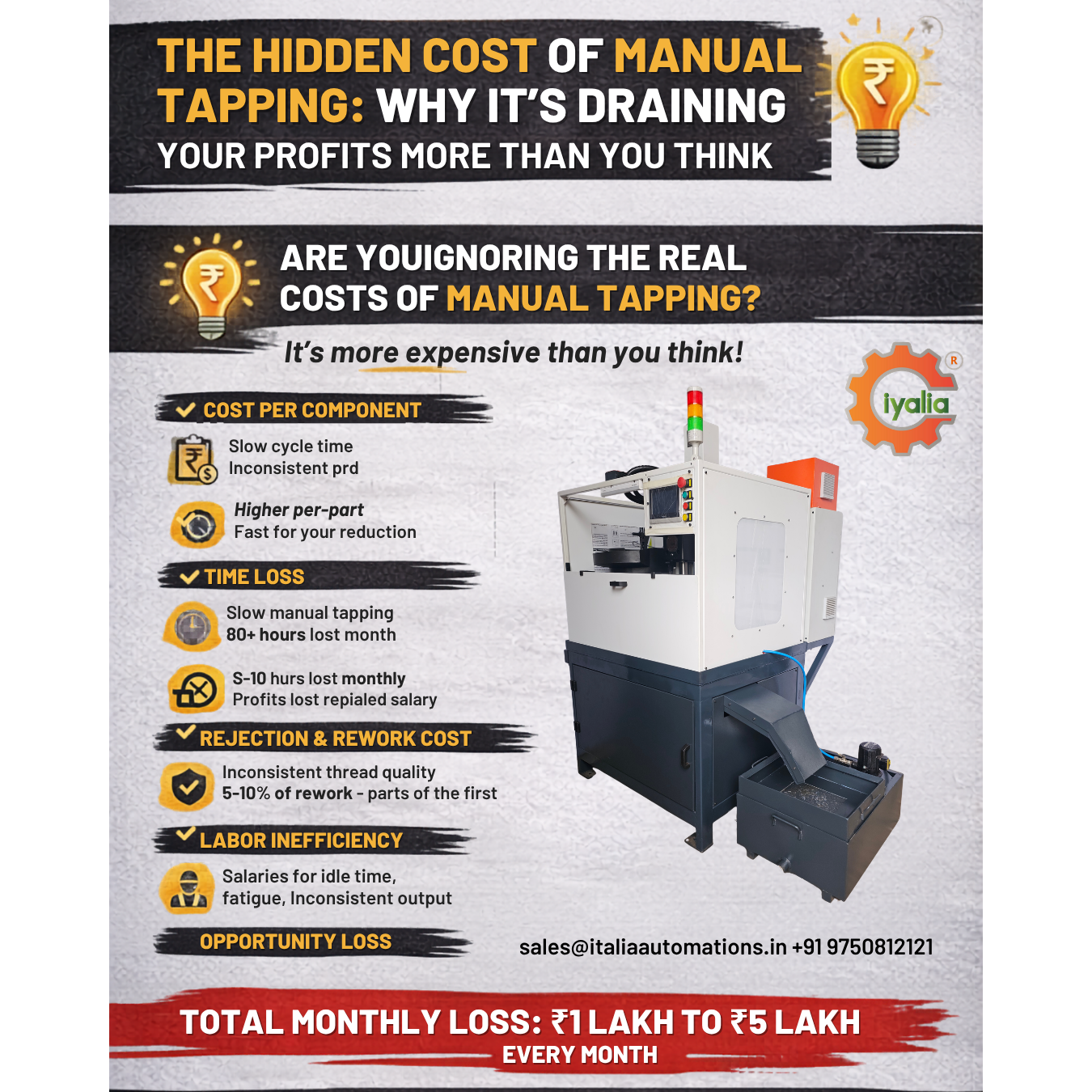
The Hidden Cost of Manual Tapping: Why It’s Draining Your Profits More Than You Think
Most factory owners think: “Manual tapping is cheaper… we don’t need automation yet.”
But here’s the truth:
👉 Manual tapping is one of the most expensive processes in your factory
(Not because of machine cost… but because of hidden losses)
🧠 The Biggest Mistake in Cost Calculation
When you evaluate tapping, you usually calculate:
- Machine cost
- Operator salary
And conclude: ✅ “Manual is cheaper”
❌ But you are NOT calculating:
- Time loss
- Rejection cost
- Rework
- Production delays
- Opportunity loss
👉 That’s where the real damage happens.
⚙️ Let’s Break Down the Real Cost
💸 1. Cost Per Component (The Truth Metric)
Manual tapping:
- Slower cycle time
- Inconsistent speed
- Idle time between operations
👉 Your cost per component increases silently
⏱️ 2. Time = Money (Daily Loss)
Let’s say:
- Manual tapping cycle time: 20 sec
- Automatic tapping: 8 sec
👉 Difference = 12 seconds per part If you produce 1,000 parts/day:
👉 You lose 3.3 hours every day
📅 Monthly Impact:
👉 ~80+ hours lost
👉 Equivalent to 10 full production days
💰 3. Rejection & Rework Cost
Manual process leads to:
- Thread damage
- Misalignment
- Inconsistent depth
👉 Even a 3–5% rejection rate costs heavily
Example:
- 1,000 parts/day
- 5% rejection = 50 parts
👉 Monthly loss = 1,500 parts
👷 4. Labor Dependency Cost
- Skilled operator required
- Fatigue reduces output
- Performance varies
👉 You are paying salary for inconsistent productivity
📉 5. Opportunity Loss (Most Ignored)
Because of slow tapping:
- You cannot increase production
- You may lose new orders
- Delivery timelines increase
👉 This is invisible revenue loss
📊 Total Monthly Loss (Reality Check)
Combining all factors:
- Time loss
- Rejection
- Labor inefficiency
- Missed production
👉 You could be losing:
💥 ₹1 Lakh to ₹5 Lakhs per month
(depending on production scale)
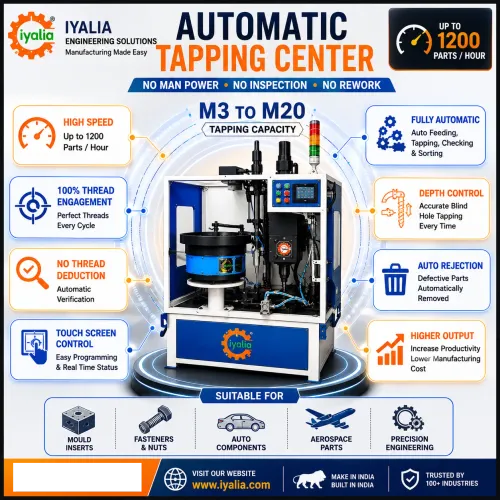
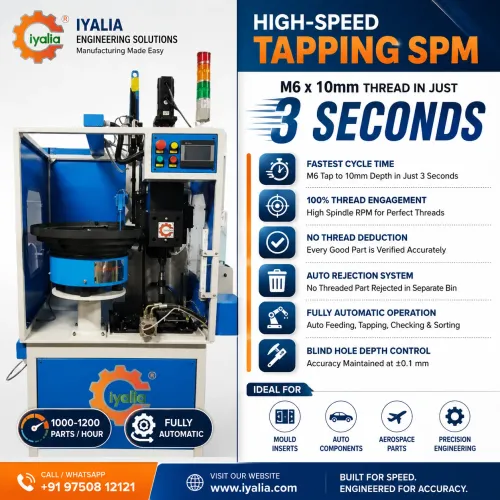
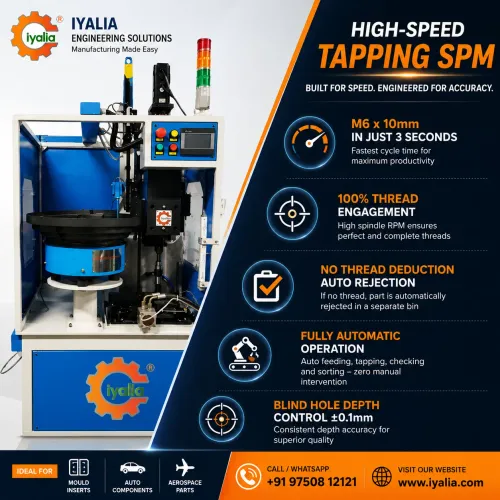
🚀 Now Compare with Automatic Tapping Machine
✅ Faster Cycle Time
Up to 3X productivity increase
✅ Lower Cost Per Component
Higher output → lower cost
✅ Minimal Rejection
Precision-controlled threading
✅ Reduced Labor Dependency
One operator can manage multiple machines
✅ Predictable Production
Better planning = better business decisions
💡 ROI Perspective (What CFOs Care About)
Instead of asking:
❌ “What is the machine cost?”
Ask: ✅ “How much money will this save me every month?”
Example ROI:
If machine saves:
👉 ₹2 Lakhs/month
Then:
👉 Payback in 6–10 months
After that?
💰 Pure profit improvement
🧠 Smart Factories Think Like This
They don’t see automation as expense.
They see it as:
👉 Profit multiplier
🏁 Conclusion
Manual tapping feels cheap…
But in reality:
👉 It is silently increasing your cost
👉 Reducing your capacity
👉 Limiting your growth
📞 Call to ActionCoimbatore
Want to calculate your actual cost per component & ROI?
👉 Contact us — we’ll break down your current process and show exact savings.