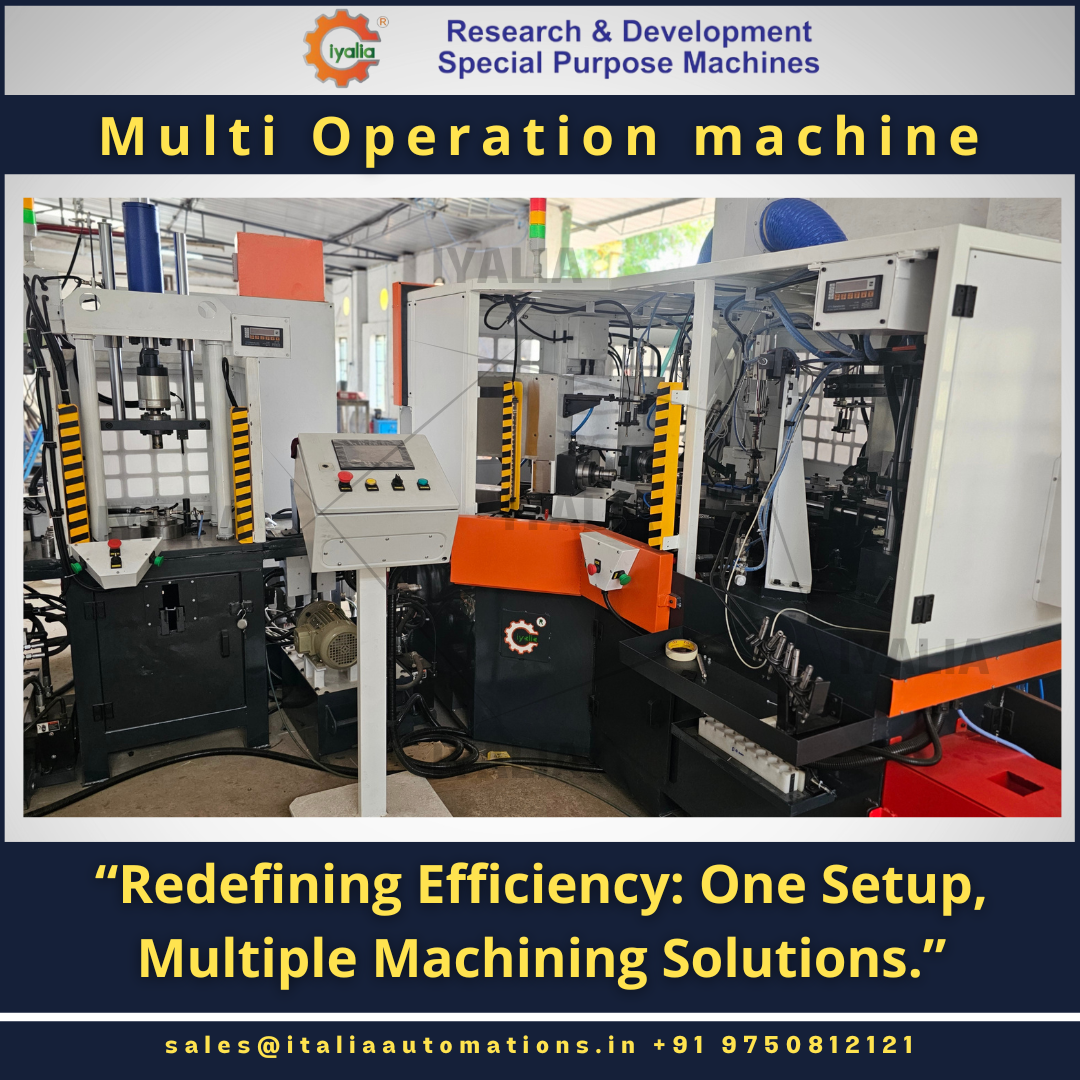
There's a common misconception on the shop floor — that adding more operations to a machine will increase the cycle time. It's an intuitive assumption, but in the world of Special Purpose Machines, it's simply not how things work.
When we design a multi-operation SPM, all the operations run simultaneously. The cycle time isn't the sum of every operation. It is determined by the single operation that takes the longest. Everything else happens in parallel. That's the fundamental engineering principle behind everything we build at Iyalia.
What operations can we handle?
Over the years, we've built SPMs that cover a wide range of metal cutting and assembly operations. Depending on your component requirement, we can configure a machine that handles any combination of the following:
Each of these can be combined in a single machine, operating on the same component in one loading cycle. One operator. One machine. Multiple operations — all happening at the same time.
The cycle time logic — explained simply
Say your component requires 10 operations: Part put together and assembly and then pressing with hydraulic press with depth control system and load cell, drilling, tapping, chamfering, counter boring, spot facing, reaming, pin pressing, and a final assembly step. In a conventional setup, you'd run these sequentially across multiple machines, with multiple operators and multiple part handoffs. The total cycle time would be the sum of every individual operation.
This isn't just an efficiency gain. It's a completely different way of thinking about production throughput.
A real machine we built — Shaft & Rotor Assembly SPM
One of the most complex machines we've engineered recently was a 12-operation semi-automatic rotary assembly machine for a shaft and rotor application. The challenge was straightforward but demanding — consolidate 12 distinct operations into one machine, operated by a single person, without any loss of process accuracy.
Here's the complete sequence this machine executes in one cycle:
- Shaft pressing into rotor— The operator loads the rotor and shaft. After part detection, pressing begins with load monitoring and confirmation on the display.
- Shaft-rotor height gauging— The operator checks height at this station. The machine confirms with a green signal before proceeding.
- Part loading with orientation check— The part is loaded with automatic orientation verification and mix-up proofing before the index to the next station.
- Spot facing— The facing tool operates under servo control with coolant, and a sensor monitors tool condition after each cycle.
- Centre drilling— Servo-controlled, with coolant flow and automatic tool condition monitoring.
- Drilling— Servo-driven drilling with coolant, and post-cycle tool condition check.
- Reaming— Servo-controlled reaming with coolant and tool monitoring.
- Hole cleaning— Compressed air purges chips and residual coolant from the reamed hole.
- Pin pressing— The pin is pressed in with load monitoring. The part moves to the next station only after confirmation.
- Pin height checking and unloading— Pin height is verified, and the finished part is unloaded using a pneumatic magnet.
Ten active stations. All are running simultaneously on different components at different stages. The operator handles loading, height gauging, and unloading — everything else is automated and verified by sensors and servo feedback.
Why servo control matters in multi-op machines
When you're running 6 or more machining operations on one machine, positional accuracy and process repeatability aren't optional — they're everything. We use servo-driven spindles and axes for all critical operations, which means feed rates, depths, and pressures are precisely controlled and monitored. Tool condition sensors add another layer of protection, ensuring the machine stops rather than producing a bad part if a tool breaks or wears beyond tolerance.
Single operator — by design, not by chance
A common concern when we propose a 10 or 12-station machine is manpower. The reality is the opposite of what most people expect. Because the machine indexes automatically, performs all operations simultaneously, and includes integrated gauging and error-proofing, one trained operator is genuinely sufficient. Loading, checking, and unloading are all that's required from the human side. The machine handles the rest.
We've been building SPMs since 2010. The machines we design today carry everything we've learned across hundreds of builds in automotive, aerospace, and general engineering. If you have a component that currently moves across 4 or 5 machines to get finished, we'd like to talk.